Sunday, October 27, 2013

Bang The Drums!


Entry Way Garden
Every had a Tofu Doughnut?

Bandō Tamasaburō in Amaterasu 


American Food: Steak

Today was our last full day in Kyoto. We have spent 6 days here and have barely scratched the surface of the city. We do feel at home here and love to just wander down the streets. After a finally shopping spree we returned to our hotel to get ready for what turned out to be one of the highlights of our trip. We went to the Minamiza Kabuki Theater. We did not go to see Kabuki but to see the  musical dance play "Amaterasu". The production features glorious dance by Tamasaburo Bando as the sun goddess Amaterasu, and Kodo performers playing taiko, koto harps, flutes and singing as they depict the gods who appear in this well-known Japanese myth.

Tamasaburo Bando is a male performer that has been awarded the title of: “National Living Treasure”. This is a way that Japan recognizes great artistry. We have seen Kodo drums many times and we always appreciated them. This was different. The giant drums were integrated into this performance. They actually were able to take on personalities. Tamasaburo Bando plays the role of the Sun Goddess with incredible dignity and dominates the stage. The drummers (they even have a female drummer) are exhausting just to watch. They never stop drumming, dancing and even singing. The audience predominately, Japanese, gave the longest ovations I have ever experienced. There must have been at least 10 curtain calls. It was a fabulous performance.

We returned to the hotel and organized our clothes. Japan has incredible delivery services. Since we were taking the train to our next destination, we were shipping some of our luggage back to Tokyo where we will be re-united with it. This shipping of your luggage, is very inexpensive and reliable. Everyone does it, rather than schlep your luggage with you.

We then when out for dinner, choosing a western style restaurant. Woops, when in Rome do as the Romans do. We should have gone for Japanese food. Typically although we had the name of the restaurant in Kanji, a map to the restaurant and the taxi driver had GPS, after calling for assistance twice, he couldn’t find the restaurant. He got out of the car and walked with us asking people where it was. Finally, I took mercy on him and made him realize it was ok, I knew we were in the general vicinity and I would find it. He left, we took 10 steps, I looked up and saw the restaurant sign. Feel sorry for the taxi driver, he will forever think he couldn’t find the restaurant, but he actually did. He just couldn’t read the sign, which was English. We walked home after dinner. Tomorrow Taxi, Bullet Train and Driver to our next destination, Hakone.


Saturday, October 26, 2013

To the Sagawa Museum and on to Tempura

Exterior of the Sagawa Museum

Gossamer Textiles Illuminated by light thru the water


Raku Displays


Noodles with fish, Yum!
Sashimi Appetiser 
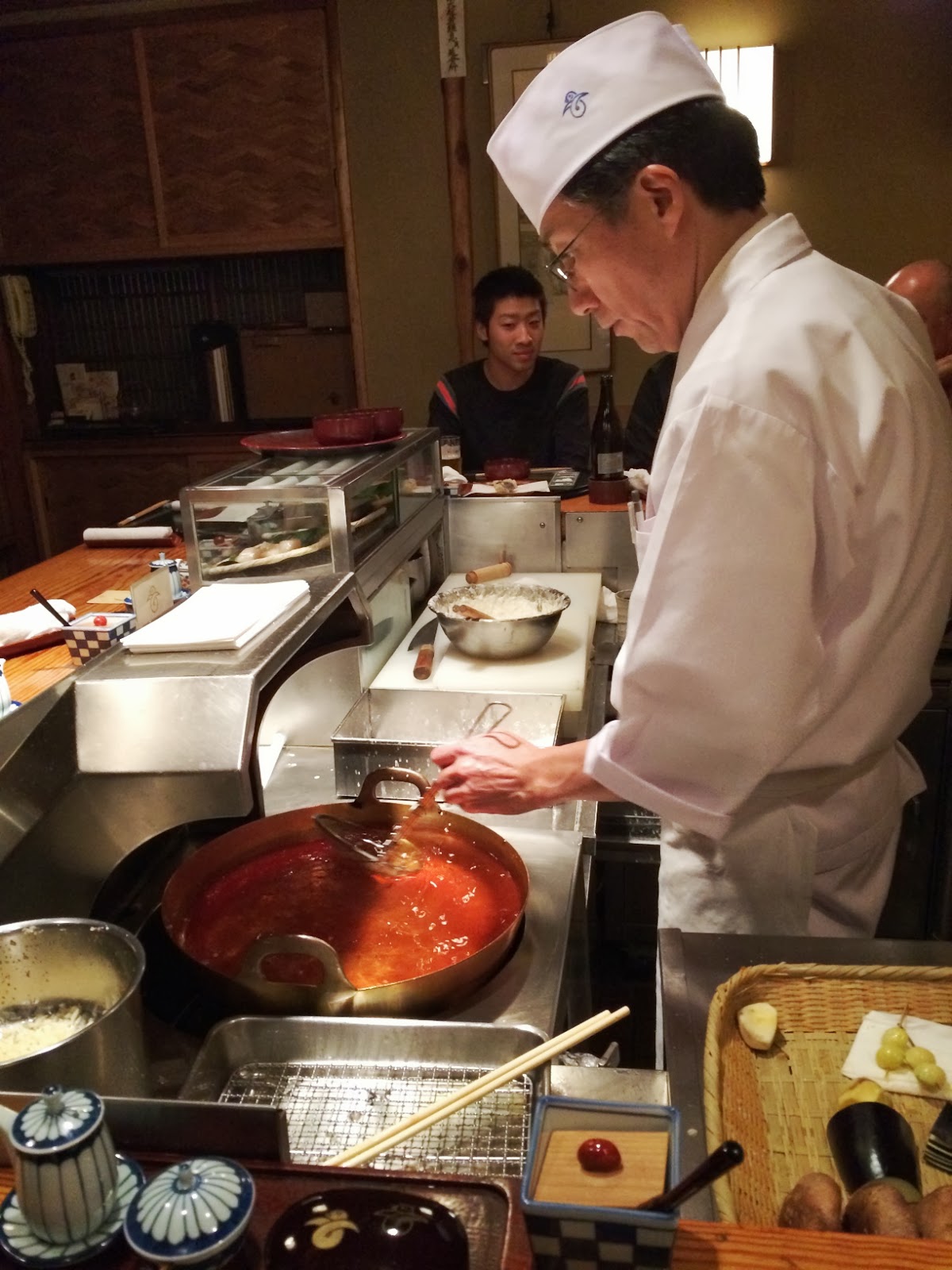
Frying Tempura

Shrimp Tempura

Scallop Tempura 
Rice with broth and Vegetable Tempura

Dessert
Garden at the Yoshikawa Restaurant

We are happy!


Robert Yellin had suggested that we visit the Sagawa Museum. He said they have an incredible display of Raku. The museum is not located in Kyoto but in Moriyama in another prefecture. We decided to go. Getting there was fun for we had to negotiate the JR Train system and figure out the correct train to get us there.

The museum is very modern and is surrounded by water. There are several different aspects to the museum but we were only interested in going to the Raku Exhibit. The museum is below ground level under the pool, light flows into the museum thru the water. Every aspect has been thought through. This is Japanese elegance distilled to its essence. Very few people were in the galleries. We essentially had the museum to ourselves. Actually there are very few Raku pots on display, maybe 20. They are lit perfectly in very dim light. It forces you to really concentrate on the objects. In addition there are beautiful textiles that are displayed. Perhaps they are showing no more than 10 or 15. By just highlighting a few items in a perfect setting the impact is breathtaking. We loved the experience and highly recommend the Raku Museum. Thanks Robert, or we never would have ventured to this museum. After lunch at the museum (Noodles with whole fish, it was great), we trained back to Kyoto and returned yet again to the Some Museum only to discover it is closed between shows. It was worth the taxi ride there, for Cathy spotted a great clothing store nearby.

We decided to have Tempura again. After our very expensive experience in Tokyo, I am happy to report we had a more satisfying Tempura Dinner in Kyoto. Yoshikawa Tempura Inn is a small ryokan hotel. It looks hundreds of years old, but since it is made of wood, I am sure it isn’t. It is charming, with old lanterns, sliding doors, a great koi pond, and fantastic tempura. They only seat 10 guests, and course after course is made in front of you. The chef speaks almost no English, so you can’t really chat with him. I consider it a victory if I can figure out the correct sauce to use. Some Tempura gets dipped in salt, others in lemon juice, others in a sauce. It was all great. For dessert they have you move from the Tempura Room to a separate room in the Inn. The night was cool and it was perfect being inside of this old building. 

Friday, October 25, 2013

The Taxi Gods and The Shirobi Welcome Cat

Honenin Temple


Sake Pitcher
In the Gallery


Noodles for Lunch at Omen with Robert Yellin
Shibori Welcome Cat
Fois Gras Pudding with Truffle

Tenderest Beef Ever


A rainy night in Kyoto

It was raining in Kyoto, but it didn’t make any difference. We decided to go to Robert Yellin’s Gallery. I also wanted to go to a restaurant for noodles called: Omen. Before we left the hotel we had them write in Kanji the address where we wanted to go. We could then show that to the taxi drivers none of whom speak English. After a ride out of the center of the city we were dropped off in front of a classic Japanese building and garden. This was not our destination, only a landmark for the taxi driver. We then had a map of how to proceed from that point to the gallery. It was pouring rain. So we trouped in the rain down the street, across a bridge, down a few more streets, pass a parking lot, up some stairs. We eventually found the gallery. I realized I didn’t bring my iphone, so I used Robert’s to take these pictures, he mailed them to me, but the resolution was poor. You get the idea however.

Robert Yellin is an expert in Japanese Ceramics and an interesting man to talk to. We spent quite a lot of time (and money) in his gallery. Although we appreciate decorative arts, we really like functional ceramics from which we can eat and drink. When it was time to leave, I mentioned that I wanted to go for noodles at Omen. Robert said great, it is a 5 minute walk in the rain from his gallery. I had no idea it was near, I expected it to be back in Central Kyoto. This was a very authentic Japanese Udon restaurant. You are served a bowl of delicious broth, a bowl of hot (or cold Udon) and a platter of very fresh vegetables.  Add them all together sprinkle with sesame seeds and you have the perfect lunch for a rainy day.

Robert suggested before we taxi back home, that we walk in the rain to a nearby Temple: Honenin. It is like a boutique Temple. It is very small but gorgeous the rain actually enhanced the experience. We were practically the only visitors.  The highlight of the Temple is the beautiful gate that as you approach it frames the temple complex and the view of the forest. All throughout Japan you are constantly aware of how architecture is used to frame views. This one was superb.

We returned to our hotel and went back out in the rain. We visited an incense shop to explore for our friend Michael the Incense use by the Royal Family. This turned out to be a bit of fools’ errand because of the difficulty in communicating. We did however sniff around and decided it was best to abandon this quest.

We have been in Kyoto long enough now to have a general sense of direction and understanding of the major streets. Taxi drivers have very sophisticated GPS and most have knowledge of the city. If they can’t find something as a last resort they call someone for sort a sort of live Google Maps. We were trying to find a museum. The Taxi driver, GPS’d, he called someone, he drover around in circles. We were getting ready to abandon ship. He gets out in the rain, he relooks at our map, he finally pulls over and says there it is. We get out in the rain. We go up to the museum. The museum is closed for the day. The vacation gods were on strike.

The rain had subsided and we decided to walk to a store that specializes in Shibori, a style of dying textiles that we like. Back into a cab to return us to our hotel. We hand the cab driver our hotel card, on one side is the name of the hotel in Japanese and the hotel phone number. (The phone number is critical because the Taxi GPS can accept a phone number and map a route to the location). On the other side of the hotel card is a map in Japanese of the hotel. Our taxi driver can not find our hotel. I by now know where we are going, this dude doesn’t. After driving all around he finally gets us near to our hotel. I indicate this location is perfect we get out and walk that last half block. We looked forward to cocktail hour!


We left our hotel walking in the rain going to a Kaiseki dinner in the Gion. The dinner was at Misogui-gawa in the Gion. The Gion is the old Geisha area of Kyoto. There are still Giesha’s here. We were shown to a private room in an old tea house. This was like stepping back into a movie from 100 years ago. Our small room was isolated by sliding shoji screens. We had two Kimono clad servers. The unique thing about this dinner was it was all haute French. There was NOTHING Japanese about it other than the setting and the concept of Kaiseki (multiple small courses). This could have been a tasting menu at a 3 star restaurant in Paris. Skipping to just one course, Cathy and I both felt that the Beef which was from Hokkaido in Northern Japan, was absolutely the most tender beef we have ever had. Not only did we eat it with a chop stick, you could cut it with a chopstick. We matched the dinner with a 2009 Pinot Noir from Bourgogne. After the dinner we staggered back to hotel oblivious to the rain. The streets were crowded with Kyoto youth enjoying their Friday night as they went from sake bar to sake bar.


Thursday, October 24, 2013

Street Walking in Kyoto

Pickle Heaven

Meat Skewers at the market

Din Tai Fung: Shumai

My Fashion Consultant, I almost bought the hat!

My kind of a museum!

Attention Red Light Shoppers

Kaiseki Dinner: Appetisers

Fig, Sea Bream, Scallop and uncurred ham

Bouillabaisse with Pike Conger, Mussel, Lobster and Matsutake Mushroom

Cold Pasta with Hairy Crab

Wagyu Beef

The Beautiful wood screen that covers the Beautiful Refrigerator


Desserts

Today was devoted to just walking the streets of Kyoto. Our hotel, The Royal Park Hotel, is located in the center of the this city of 1.2 million people. It has easy access to public transportation (subways, busses and taxis) and all of the stores that you can imagine. It must rain a lot here (the sidewalks are covered and there are several arcades that run for blocks and blocks. It drizzles off and on, then stops. The natives clearly are totally used to the weather. I haven’t seen anyone in a raincoat. All most all of the stores, taxis and hotels offer free umbrellas. You take one and leave it where ever. The next person then can use it if they need it. It is a great civic sharing experience.

We did a lot of walking and shopping today, mostly were buying gifts. Kyoto has a very high taste level and there are lots of expensive antique stores (we didn’t buy anything). It also has a contemporary side to it. If you looked at the youth they all seem to be dressed with great style in a “grunge look”. They would look great in Silverlake or Seattle or San Francisco. Simultaneously you see women in Kimono’s. They are honored here, and get special benefits. For example, a women in a Kimono gets a discount if she takes a taxi.

Walking thru the Nishiki Food Market was a repeat for us from previous trips, but totally interesting. It is a covered arcade spanning many blocks. On either side of the street are stalls dedicated usually to a single item. Fish Stalls, Rice Stalls, Vegetable stalls, knife stall, sweets etc. The Japanese are obsessively clean and there are no flies, no garbage, no smells or odors that shouldn’t be there. You would NEVER see a Japanese person walking down the street eating food or throwing away trash on the street, it just isn’t done here.

We decided to have lunch at Din Tai Fung at Takishimaya. We have eaten many times at DTF in Los Angeles. It is a branch of a Taiwanese Restaurant. Scott had always told us the one in Taiwan is far better. It turns out that the branch in Kyoto has a far more expansive menu than the Los Angeles one. (Note to self: Check out the new one opening in Glendale, see if has touches of Armenian cooking). For me the test of a Dim Sum is shumai. The shumai here was unlike any I had ever had, the dough contained soup within it, like so many DTF dishes in LA. I don’t know which is authentic, but this soup dumpling version was excellent.

Japan takes earthquakes very seriously. As we were walking down the street music plays over loud speakers. It is really quite insipid. American movie music from the 60’s played like elevator music. All of a sudden a voice came on, first English then in Japanese saying this was a test of the earthquake alarm system. Then there was a siren. The siren subsided and then the insipid music returned. I guess they have some sort of technology to give them a short window of opportunity before an earthquake hit. Ok, lets think I am walking down the sidewalk and an alarm goes off: Earthquake! What would you do. Run into the street and get hit by a car, run into a collapsing building, I don’t know what I would do? I always wanted to be in front of a jewelry case in at Tinfany’s infront in the advent of an earthquake, what about you?

As insipid as a lot of the music is, surprisingly in lots of stores and restaurants we have been in they have been playing very progressive Jazz and Bebop. I always am reminded when I hear this type music of the way it is used in the novels of Murakami. I now know where he gets his inspiration.

Dinner was at another Kaiseki restaurant: Yonemura. This is an absolutely gorgeous restaurant. They dumped a ton of money into it. It has an ultra-modern kitchen with counters and drawers made of wood. The architecture and craftsman who built this restaurant were great combining new equipment with the eternal Japanese love of nature and wooden objects.

The dinner was excellent but very filling. I can’t believe we are doing another and different Kaiseki dinner tomorrow night!


Wednesday, October 23, 2013

The Full Kyoto Experience

Fushimi Inari Taisha Shrine Kyoto


Old Kyoto

Lunch in Kyoto

Back on the Indigo Trail

Masa and the sliding screens by his wife: Sarah

Sarah's Painting

Kaiseki at Giro Giro

Sashimi Course

Pork Course

Rice with Fish


This was a very full day of the Kyoto experience. We did a lot! Masa, our guide, met us at the hotel. It was raining so we taxied to Fushimi Inari Taisha Shrine wanting  to learning more about the Shinto Religion and visit the incredible Torri Gates. There are over 3500 gates at the Temple leading from the rear of the temple up a curved walkway to the summit of the mountain adjacent to the Temple.

I thought there would be no way we would enjoy the place, it was raining, and there would a multitude of people walking beneath the gates. It turns the rain stopped and there were plenty of times to take pictures. We did the Shinto Ritual before entering the Shrine: Wash Hands and Face, Ring Bell, Bow, Clap, Bow, Clap. For additional insurance I tossed some coins into the Shrine. Well, it stopped raining, the sky cleared, and the crowds disappeared, I got my pictures!

From the Shrine we took a local commuter line into the city. Masa walked us around showing us where we could return to shop. We then got into some serious shopping. This is really a great town for shopping. It has a craft tradition that has been revitalized and you find unusual things here.

For lunch on a rainy day in Kyoto, hot noodles! More shopping, and then as a real treat Masa invited us to his house for Tea. He lives a short distance from downtown Kyoto in a house he designed himself (he is an architect). It is very large and beautiful. The main house, is put together with NO nails. Everything is tongue and groove with wooden pegs holding up the beams together. It is amazing! Masa’s wife Sarah is a wonderful artist and her paintings are through out the house. She has a studio adjacent to the house and we viewed her painting in progress. We then taxied back to the Hotel (It is hard to get a taxi in the rain in Kyoto as it is in New York City).

Drinks at the bar, then a taxi to Giro Giro, a Kaiseki restaurant. Kaiseki dinners are dinners served of small portions, all seasonal - Kyoto is renown for this style of eating. The restaurant has a set price you simply sit down and they start serving you. Giro Giro is a hard restaurant to get into and we were looking forward to the meal. The problem was finding the damn place. We had directions, I am sure if we followed them to the letter we might have found the restaurant, but it didn’t work out that way. We told the cab driver where we were going (by showing him Kanji lettering that said: Drop us off at the intersection of two streets). We were then supposed to follow a map to find the restaurant down a narrow alley. Finally identifying the restaurant by its Kanji name. To us all of the Kanji looks the same or similar - especially after a Martini. The cab driver realized where we were going - thankfully the restaurant name was also written in Kanji. He parked his taxi, then he retrieved two umbrellas for us and walked us down the street then down an alley delivering us to the restaurant door. Could you picture anywhere else where that would happen? In Japan outside of the tourist spots (Hotels, high-end restaurants, etc.) English is NOT spoken. It is fun trying to communicate when the other party doesn't speak your language.

The dinner was great. Each course was a hit, the Sake made it all the better. We sat at a Sushi like counter as we watched each dish prepared in front of us. Because of the covered walkways, and the warm noodles for lunch, Kyoto is a great city to enjoy in the rain.